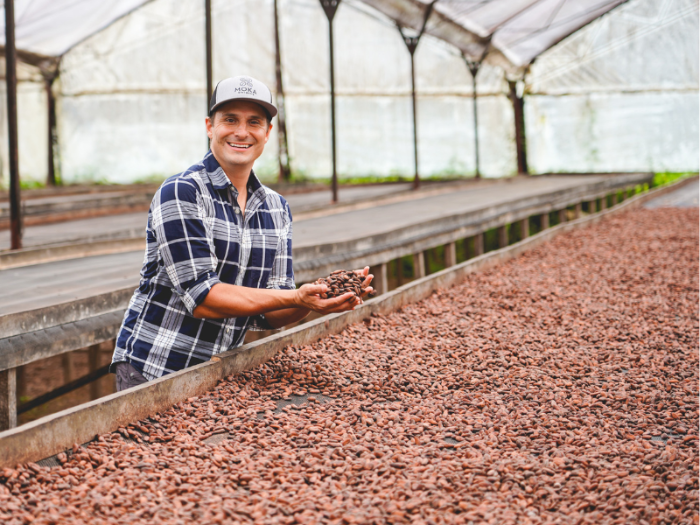

What started as a small community farming initiative in Cameroon has blossomed into a mission-driven brand making waves in both the chocolate and coffee worlds. SFA member Moka Origins was founded on the belief that ethical sourcing and exceptional flavor can—and should—go hand in hand. From bean to bar and crop to cup, the company is committed to direct trade, farmer training, and environmental stewardship, with over one million trees on track to be planted by next year.
Founder Jeff Abella recently shared with SFA how Moka Origins blends bold taste with social impact, what it was like debuting at the 2025 Summer Fancy Food Show, and why thoughtful growth—both at home and at origin—is at the heart of everything they do.
Moka Origins began as a community farming project in Cameroon. Can you share how that origin story shaped your mission, and how it continues to guide your coffee and chocolate production today?
Absolutely. I moved to Cameroon in my early 20s to lead a nonprofit community development program focused on health and education. Much of our work was based in cacao and coffee-growing regions, and that’s where I saw firsthand how broken and unequal the supply chain was for smallholder farmers.
It sparked something deeper in me. I wanted to do more than just offer aid—I wanted to build a business that created long-term, equitable trade opportunities. That’s how Moka Origins was born: from the ground up, as a way to build a better system. Today, we’re still guided by that same mission. We buy direct, support farmer training, and reinvest in the communities we source from—especially through our tree-planting and education programs.
You craft both bean-to-bar chocolate and small-batch coffee, with a focus on farmer training and tree planting. What are the unique challenges—and rewards—of operating across these two craft categories?
The biggest challenge is the complexity. Chocolate and coffee require completely different skill sets, equipment, and sourcing logistics—not to mention building a factory capable of producing both at scale. It’s twice the work. But it’s also twice the impact. Operating in both categories allows us to deepen relationships with farming communities, offer year-round support, and diversify the types of training and development we can provide.
From a customer standpoint, it’s incredibly rewarding to bring them along on that journey—connecting the dots between their morning cup of coffee and the chocolate they might enjoy that evening, all while knowing it’s supporting farmers and reforestation at origin.
This summer was your first year exhibiting at the Summer Fancy Food Show. What motivated you to participate, and how did the SFFS audience respond to your coffee-meets-chocolate approach?
We joined SFFS to introduce Moka Origins to a broader national audience and connect with retailers who care as much about quality and sourcing as we do. The response blew us away. People were curious about the combination of bean-to-bar chocolate and specialty coffee under one roof—and once they tasted the product and heard our sourcing story, it all clicked.
We kept hearing the same feedback: “You can taste the difference, and now I understand why.” That connection between impact and flavor was powerful.
Looking back on your debut at the show, was there one unexpected interaction, trend, or lesson that surprised you?
Yes—how much buyers and distributors wanted to talk about sustainability beyond just certifications. They asked about regenerative farming, packaging decisions, and how we support our team here in the U.S. It was a great reminder that today’s retailers want brands that don’t just talk the talk—they want to see mission and impact baked into every part of the business.
Moka Origins highlights signature blends and single origins (like Ethiopia Masha Farm or Cameroon Mt. Oku). Which products sparked the most excitement this summer, and what makes them stand out?
On the coffee side, our Direct Trade Uganda from the Mt. Elgon region and our Fair Trade Guatemala were standouts. People were drawn to their complex flavor profiles—floral, spiced, and naturally balanced—but also to the sourcing stories behind them. There’s something powerful about knowing exactly where your coffee comes from and the impact it has.
On the chocolate side, our new Quinoa Crunch Milk Chocolate Bar created a lot of buzz. It’s sweet, crunchy, and packed with protein—while staying true to our values of clean ingredients, ethical sourcing, and transparency. It’s a fun and flavorful entry point into our mission and product line.
As a growing brand with strong social impact and craft credentials, where do you see Moka Origins headed next?
We’re scaling thoughtfully—but extensively. Our newly expanded factory and public-facing chocolate café give us the infrastructure to grow while staying connected to our consumers. It’s more than just a production space—it’s a place where customers can witness the entire process, from cocoa bean to chocolate bar.
Our next step is national expansion through key retailers and distribution partners, with a focus on deepening our presence in the natural channel. We prioritize building strong, direct relationships with our retail partners to help them communicate the quality, transparency, and mission that resonate so strongly with their customers.
At the same time, we’re expanding our impact at origin—planting more trees, growing our farmer training programs, and investing in sustainable agriculture across West Africa. We’re on track to plant 1,000,000 trees by the end of next year.
The next 24 months are a pivotal chapter as we continue building a brand—and a supply chain—that works for everyone involved.
Learn more about Moka Origins and explore their full line of ethically sourced chocolate and coffee at mokaorigins.com. Follow along on Instagram @mokaorigins to see how they’re planting trees, empowering farmers, and crafting incredible flavor—one bean at a time.
How Moka Origins Stirred Up Buzz at the Summer Fancy Food Show